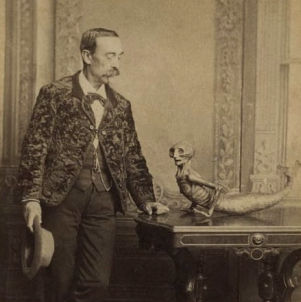
A TABLE MADE OF HUMAN ORGANS

Among the gifts presented to Napoleon III was a table assembled from human remains. This table is still on display at the Paris Museum of the History of Medicine, and you can go see it. It was crafted by the Italian naturalist Efisio Marini: the tabletop features a fossilized brain, blood, bile, a liver, lungs, and glands, and on top of that – a leg, four ears, and fragments of spinal segments.
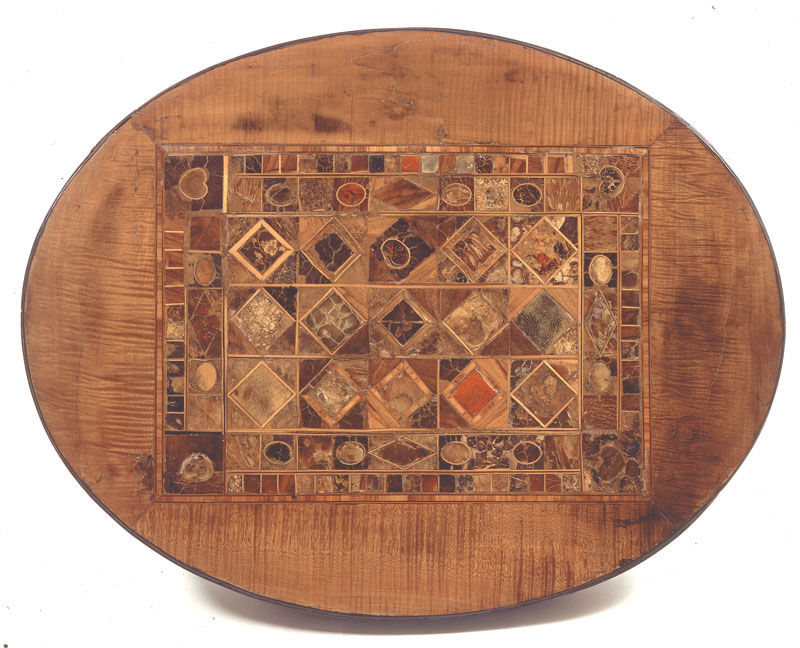
But this story does not begin with Napoleon; it begins with the Egyptian expeditions that turned Europeans’ perceptions upside down in the early 19th century. An Italian named Girolamo Segato (1792–1836) traveled to Egypt, studied the secrets of ancient mummification, and returned with an idea that seemed both scientific and fantastical at the time: not to preserve the body as a shell, but to transform it into a material – to make the soft hard, the organic – mineral. He began conducting experiments on fragments of corpses and developed a technique for their artificial petrification. A table made from 214 petrified human organs became the first known example of the use of human remains as furniture decoration. Also in that collection: petrified hands, feet, embryos, a woman’s breast – virtually indistinguishable from a marble sculpture – and an entire woman’s head with long blond hair, glass eyes, and parted lips. All of this is housed in the Florentine Anatomical Museum. For better or worse: Segato took the secret of his technique to his grave. His colleagues refused to acknowledge him and called him a sorcerer. And it’s hard to blame them for that.
But Segato was not alone – neither in his experiments nor in his fate. In his book “The Adorned Body: Dissection and the Human Body in Renaissance Culture”, science historian Jonathan Souday shows that the line between anatomist and magician was never a fixed one: whoever dissected a body and knew what lay within automatically found themselves on the other side of the boundaries of the knowable. The anatomical theaters of the 16th and 17th centuries were built precisely as theaters – with spectators, seasonal performances, and an audience that paid for admission – and were not open exclusively to students. The body on the table was simultaneously an object of science and a spectacle, and no one distinguished between these two roles at the time.

Much the same story repeated itself with two other Italian scientists of the same period. Paolo Gorini began as a volcanologist, moved to experiments on human remains in the 1840s, and earned the nickname Il mago di Lodi - the Wizard of Lodi. He was the only one of the three to achieve recognition during his lifetime, though he too never revealed his secret. Efisio Marini went further: at the World Exhibition in Paris in 1867, he presented the foot of an ancient Egyptian mummy to which he had restored the softness and flexibility of living flesh. Napoleon III did not believe his eyes and arranged a test - his court physician took a mummified foot, made a hole in it, attached a note with the date, and gave it to Marini. A month later the foot was soft again. Napoleon awarded the Italian the Legion of Honor.
In Italy, he was still considered a sorcerer. The university closed its doors to him. He threw some of his works into the sea. He died in isolation—far from his colleagues and from anyone who might have understood him.
Historian Lyudmila Yordanova, in her study of representations of the body in 18th- and 19th-century science, notes an important point: during this period, the body was perceived through the metaphor of a mystery to be unraveled—nature as a woman whom science must “uncover.” This explains why the works of Segato and Marini aroused such fear: both scientists did not merely study the body; they transformed it into an object—a thing, an article. They crossed a line that the science of their time had not yet dared to cross openly.
Juliette Kaz, who studies these stories professionally, notes that all three were condemned during their lifetimes and only gained recognition after their deaths. People feared them, calling them sorcerers, alchemists, and beings not of this world – and then went on to display their works in museums. The cabinet of curiosities has a similar history: the line between scientist and magician lay precisely where the rational explanations of the time ended.
Text by Lera Salynskaia for Curiothèque LAB
Sources:
Juliette Caze, Cabinets de curiosités anatomiques, médicaux et macabres;
Jonathan Sawday, The Body Emblazoned: Dissection and the Human Body in Renaissance Culture (Routledge, 1995);
Ludmilla Jordanova, Sexual Visions (Harvester Wheatsheaf, 1989);
Image source:
Girolamo Segato, Tavolo intarsiato (Inlaid Table with petrified human organs), ca. 1830–1834. Collection of the Museo Galileo, Florence.
Efisio Marini, Anatomical Table, 1866. Musée d'Histoire de la Médecine, Paris.
Museum of the Department of Anatomy at La Specola, Florence (in our museum database soon)
Florentine Anatomical Museum (in our museum database soon)