HOW TO TURN A MONKEY AND A CARP INTO A SENSATION OF THE 19TH CENTURY

Updated: Jul 22
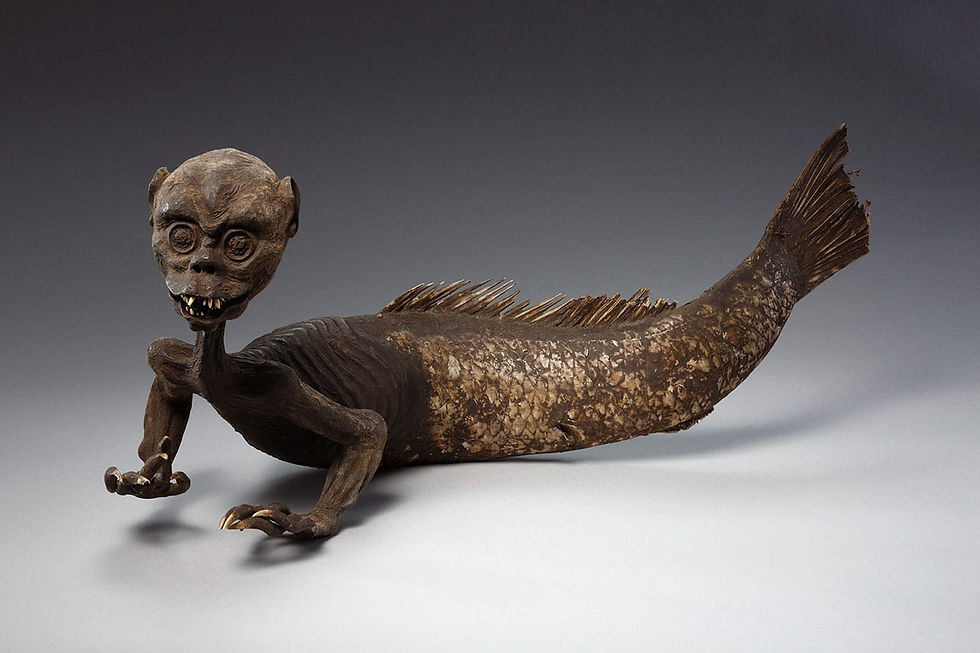
In 1842, a mermaid appeared in New York. She was first exhibited at Concert Hall on Broadway, then moved to Barnum's American Museum. Newspapers wrote that she resembled "the very embodiment of ugliness": the torso of a monkey, the tail of a carp, a gaping mouth, stretched skin. Barnum skillfully used the criticism and displayed the review at the entrance. The queue doubled. No better advertisement could have been devised.
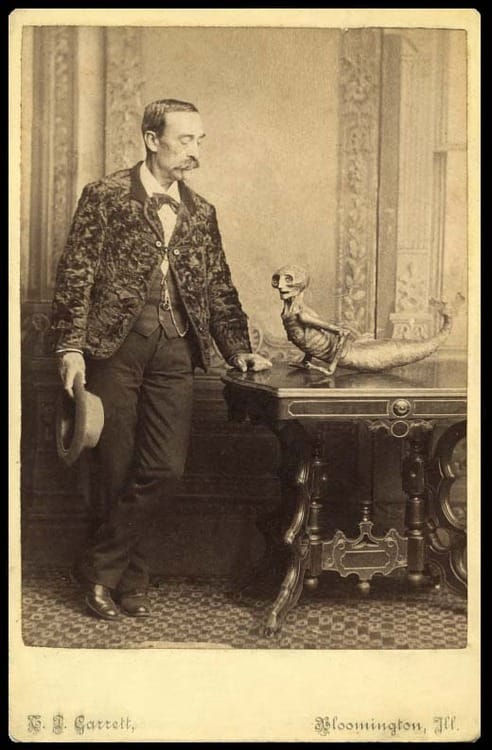
The most remarkable thing: he never claimed she was real. But he never said she was fake either. He simply invited people to come and see this marvel, playing on human curiosity.
Her story is this: she was made in Japan, where such creatures, ningyo, literally "human fish," were kept in Buddhist temples and regarded as a symbol of longevity. A single glance at her, it was said, would extend a life. Craftsmen assembled them from fish bones, monkey skulls, plant fibres and wire, building a body from whatever came to hand. In 2022, one such object was found in a sealed box at a temple in Okayama and immediately X-rayed. Inside were fragments of many animals assembled into a single creature. In other words, a cabinet of curiosities in miniature.
It is worth noting that the public of 1842 wanted to see her, and this desire predated Barnum by several centuries. People wanted to understand exactly where the boundary lay between the real and the supernatural. In those days it was not yet so clearly drawn. "Exotic" and "impossible" were neighbouring categories rather than opposites.
In his book Myths of Fossils, Anton Nelikhov tells the story of a peasant who, in 1846, found a mastodon tusk on the riverbank and immediately concluded that it was the horn of a unicorn – the very one “that refused to enter Noah’s Ark during the Flood and remained on Earth.” There was no deception involved. It was simply another way of explaining the world, in which a large, strange bone found in the clay instantly turned into a beautiful legend.
What Barnum did in 1842 was, in essence, a brilliant marketing campaign. He wasn’t selling his audience a mermaid. He was selling a sense of mystery – the very same sense that cabinets of curiosities had been creating for three centuries.
Robert Ripley at the 1939 New York City odditorium. Photograph from Ripley Entertainment Inc
The Feejee Mermaid and the myth around her still exist today, or more precisely, several objects claim the title, since the original was most likely destroyed in the fire at Kimball's Boston Museum in the early 1880s, while others surface at auction houses, museum storage rooms, and private collections. Each time scientists examine them. Each time they find the same thing: wire, fish, monkey, craft.
Text by Lera Salynskaia for Curiothèque LAB
Sources:
Juliette Caze, Cabinets de curiosités anatomiques, médicaux et macabres;
Anton Nelikhov, Myths of Fossils (MIF, 2025) - Currently available in Russian only.;
Joseph Alsop, The Rare Art Traditions (Harper & Row, 1982)
Image source:
Robert Ripley at the 1939 New York City odditorium. Photograph from Ripley Entertainment Inc.
Wikipedia and Wikimedia, the free encyclopedias
Horniman Museum and Gardens
Photo by Thomas J. Garrett, Bloomington, Illinois, c. 1870–1880. McLean County Museum of History Collection. Public Domain.
Sights in Boston and suburbs, 1856. Courtesy of Internet Archive Book Images / Flickr. Public Domain.


