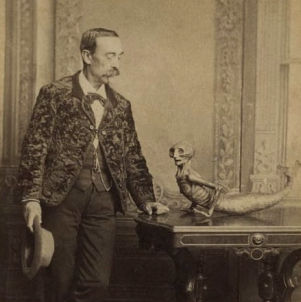
PLEASE DO NOT ASK WHAT'S IN THE JAR

Before the nineteenth century, a pharmacy looked nothing like it does today. Walk into one and you would find shelves from floor to ceiling lined with jars: snakes floating in liquid, dried crocodiles, powders made from things you would rather not know existed. Science, magic, and the trade in curiosities all lived under one roof.

Scent was part of this system, but as medicine. Ruth Goodman, a BBC historian of Tudor daily life, describes a world in which smell literally entered the body: sixteenth-century physicians believed that through two small organs at the top of the nostrils, aromas passed directly into the brain, carrying what they called "vital spirits." Rosemary strengthened memory, which is why it was carried before the bride at weddings and placed in the hands of the dead at funerals. Lavender cooled an overheated brain. Bundles of marjoram and rosemary were burned and carried through a sick person's room as disinfection. Those who could afford it went to the apothecary for distilled rosewater: drunk, sprinkled on collars, added to food. From the same quantity of raw material, rosewater could be produced fifty times more abundantly than rose oil, which made it the apothecary's product for the middle classes.
One of the most expensive medicines of the sixteenth and seventeenth centuries was the bezoar, a stone from the stomach of a goat or horse, a mass of undigested matter. It was sold as a universal cure: for broken bones, for melancholy, for poison. A large bezoar in a gold setting was a status symbol, worn as jewellery, stolen, faked. Jesuits in Goa made imitations from hair, resin, and bone fragments and sold them to European apothecaries as the genuine article. This story concerns Ambroise Paré, surgeon to the French court under four consecutive kings. In 1567, a cook caught stealing silver from the royal kitchen was sentenced to hang. Paré offered him a choice: the gallows, or poison followed immediately by a bezoar. If he survived, he would go free. The cook agreed. He died in agony several hours later.

Much the same story repeated itself with two other Italian scientists of the same period. Paolo Gorini began as a volcanologist, moved to experiments on human remains in the 1840s, and earned the nickname Il mago di Lodi - the Wizard of Lodi. He was the only one of the three to achieve recognition during his lifetime, though he too never revealed his secret. Efisio Marini went further: at the World Exhibition in Paris in 1867, he presented the foot of an ancient Egyptian mummy to which he had restored the softness and flexibility of living flesh. Napoleon III did not believe his eyes and arranged a test - his court physician took a mummified foot, made a hole in it, attached a note with the date, and gave it to Marini. A month later the foot was soft again. Napoleon awarded the Italian the Legion of Honor.
In Italy, he was still considered a sorcerer. The university closed its doors to him. He threw some of his works into the sea. He died in isolation—far from his colleagues and from anyone who might have understood him.
Historian Lyudmila Yordanova, in her study of representations of the body in 18th- and 19th-century science, notes an important point: during this period, the body was perceived through the metaphor of a mystery to be unraveled—nature as a woman whom science must “uncover.” This explains why the works of Segato and Marini aroused such fear: both scientists did not merely study the body; they transformed it into an object—a thing, an article. They crossed a line that the science of their time had not yet dared to cross openly.
Juliette Kaz, who studies these stories professionally, notes that all three were condemned during their lifetimes and only gained recognition after their deaths. People feared them, calling them sorcerers, alchemists, and beings not of this world – and then went on to display their works in museums. The cabinet of curiosities has a similar history: the line between scientist and magician lay precisely where the rational explanations of the time ended.
Author of the text Lera Salinskaia
Sources:
Juliette Caze, Cabinets de curiosités anatomiques, médicaux et macabres;
Jonathan Sawday, The Body Emblazoned: Dissection and the Human Body in Renaissance Culture (Routledge, 1995);
Ludmilla Jordanova, Sexual Visions (Harvester Wheatsheaf, 1989);
Image source:
Girolamo Segato, Tavolo intarsiato (Inlaid Table with petrified human organs), ca. 1830–1834. Collection of the Museo Galileo, Florence.
Efisio Marini, Anatomical Table, 1866. Musée d'Histoire de la Médecine, Paris.
Museum of the Department of Anatomy at La Specola, Florence (in our museum database soon)
Florentine Anatomical Museum (in our museum database soon)